
Many real estate investors purchase rental properties in an LLC for liability protection, estate planning, or 1031 exchange purposes. A common question that comes up during the insurance process is:
If my rental property is owned by an LLC, do I have to buy commercial insurance?
The short answer is:
Not necessarily.
The confusion often comes from the difference between the property’s use and the insurance policy form a carrier chooses to use.
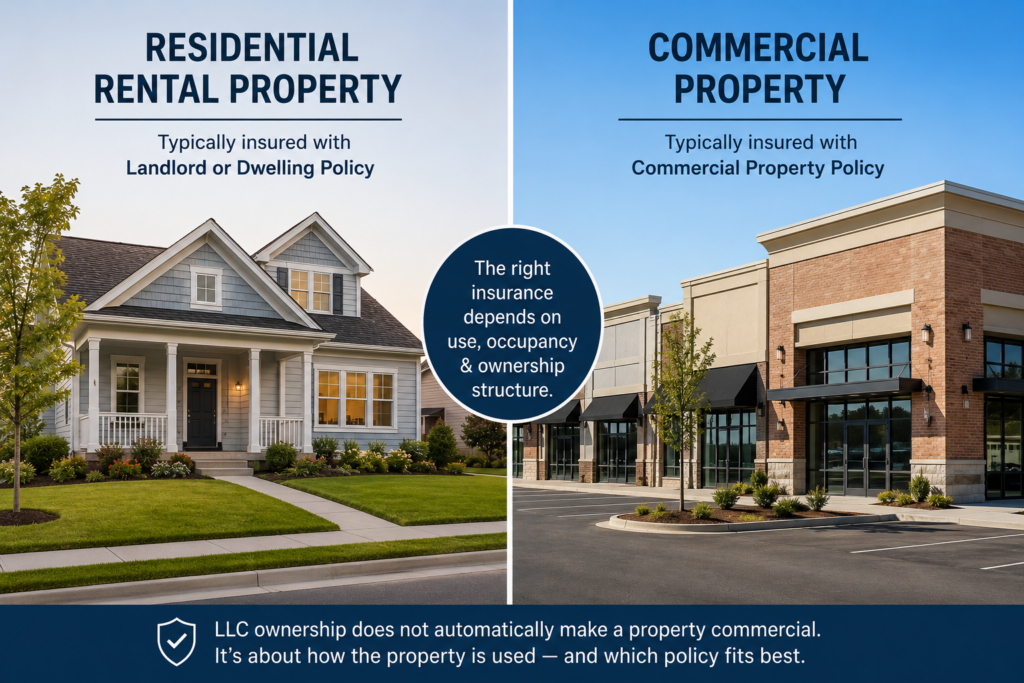
The Property Is Still Residential
Let’s start with the property itself.
If the property is:
- A 1-4 unit residential dwelling
- Rented to long-term tenants
- Not used as a short-term rental
- Not operated as an apartment complex or business facility
then it is generally considered a residential rental property from an underwriting standpoint.
The fact that ownership is held by an LLC does not automatically change the property’s occupancy or use.
A single-family rental home owned by an LLC is still a single-family rental home.
Why Some Insurance Companies Say You Need Commercial Insurance
This is where things get confusing.
Some insurance companies allow LLCs to be listed as the Named Insured on a residential landlord policy.
Others do not.
When a carrier does not allow LLC ownership on its residential landlord forms, it may require the property to be written on a commercial property policy instead.
In that situation, the insurance company is making a decision based on its underwriting rules and available policy forms—not because the property itself suddenly became a commercial building.
The risk has not changed.
Only the carrier’s paperwork and filing structure have changed.
Example
Consider two identical rental homes:
Property A
- Owned by John Smith personally
- Long-term rental
Property B
- Owned by Smith Family Properties, LLC
- Same location
- Same tenants
- Same rental income
One carrier may write both properties on the exact same landlord policy form.
Another carrier may write Property A on a dwelling fire policy and require Property B to be written on a commercial property form.
The exposure is identical.
The difference is the carrier’s underwriting guidelines.
What About California FAIR Plan?
California property owners frequently encounter this issue when insuring homes in wildfire-prone areas.
In many situations, investors use a combination of:
- California FAIR Plan for property coverage
- Difference in Conditions (DIC) policy
- Landlord liability coverage
Whether an LLC-owned rental property can be written using residential forms or must use commercial forms depends on the current underwriting rules of the FAIR Plan and any companion carrier involved.
The answer is not always the same from one insurer to another.
When Commercial Insurance May Actually Make Sense
There are situations where a commercial property policy may be appropriate regardless of ownership structure, including:
- Apartment buildings
- Mixed-use buildings
- Large rental portfolios
- Properties held within complex business structures
- Properties with significant business operations beyond traditional residential leasing
In those cases, commercial coverage may provide broader flexibility and better fit the ownership structure.
The Bottom Line
Owning a rental property in an LLC does not automatically mean the property is a commercial risk.
More often, the question is:
Which insurance companies are willing to insure an LLC-owned residential rental on a residential landlord policy form, and which require a commercial property form?
For real estate investors, especially those purchasing properties through LLCs for liability protection or 1031 exchange planning, it is important to work with an independent insurance advisor who can evaluate multiple carrier options rather than relying on a single company’s underwriting rules.
The property’s ownership structure matters—but it does not automatically determine whether the risk is residential or commercial.
Need Help Insuring an LLC-Owned Rental Property?
Vantage Point Risk works with real estate investors throughout the Western United States and can help evaluate landlord insurance, FAIR Plan options, DIC coverage, and alternative admitted and non-admitted markets for LLC-owned residential rental properties.
Contact us to review your property and ownership structure before assuming commercial coverage is your only option.